Big
2017-05-01
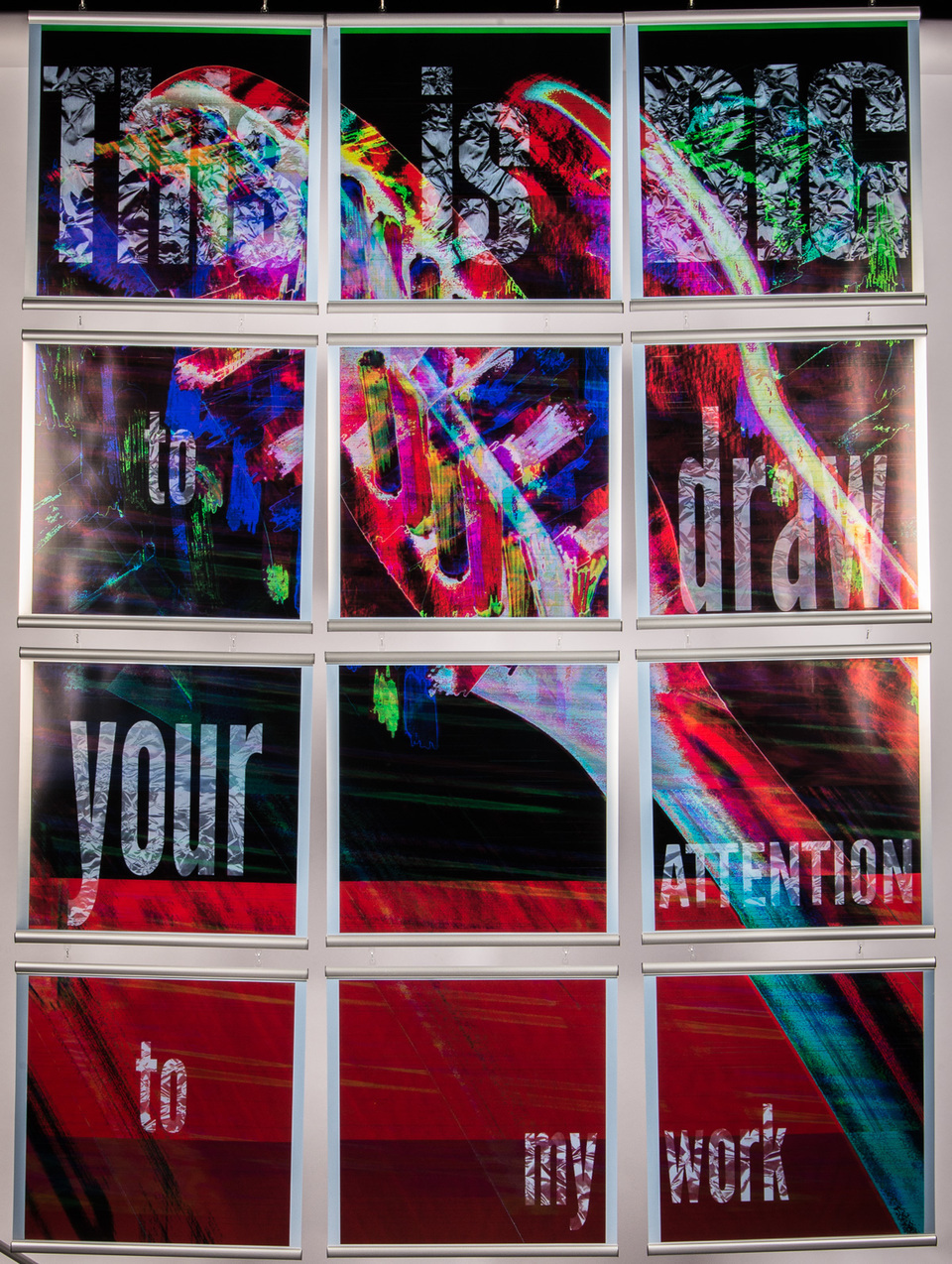
Each segment (approximately 2'×2') is printed on metallic paper and individually hung on poster frames. With the support it is about 7 feet wide by about 10 feet high.
2017-05-01
Each segment (approximately 2'×2') is printed on metallic paper and individually hung on poster frames. With the support it is about 7 feet wide by about 10 feet high.
As a photographer, I feel that there is a “right” size for every image, and it’s not always “as big as possible”. I started thinking about why artists would make large pieces. How could I make a piece that would be as big as I could possibly make it and still have it be “right” size?
Starting from a single medium format film negative, I scanned it at high resolution and brought it into Photoshop to color it. Then I loaded the resulting file into the open-source digital audio editor Audacity, and used its controls to “glitch” the image — adding intentional but not entirely controllable noise and other effects.
After adding the text (and enhancing it with a scanned texture), I then used another open-source program ImageMagick to chop the file into twelve segments for printing (on metallic paper) and display.
Big is the largest piece I’ve ever made.